Sunday, November 30, 2014

Hauling Coke on the Southern Pacific Santa Barbara Subdivision

Yet another train for the SP Santa Barbara Subdivision...petroleum coke.

This train originates at Callender and carries petroleum coke produced at the refinery there.  The refinery was originally owned by Union Oil of California.  It has changed hands several times including Tosco, Conoco, and now, Phillips.  The 'green' coke was further processed at an adjacent facility originally operated by Collier Carbon and Chemical Co., a wholly owned subsidiary of Union Oil of California.  The calcining plant heated the green coke and drove off more impurities as well as slightly changing the physical nature of the coke, making it a more efficient fuel source.  The calcining plant was closed in March 2007 to reduce air pollution in an agreement with the local air pollution control district.  Information about the closure and the coke stockpile reduction is available in the Conoco Phillips Santa Maria Refinery Throughput Increase DEIR (draft environmental impact report) starting on page 2-13. 
The report also includes reference to multiple unit trains, typically 22 cars each carrying approximately 100 tons of green coke, transport a shipload of petroleum coke to the ports.
There was a bulk loader in San Pedro.  I remember it in the late 60's and was intriqued by the rotary dumper.  It was just off Miner Street, but that is all gone now, replaced by yacht marinas.
   
In previous times unit trains were sent north over Altamont Pass to the Port of Stockton and also to Trona via a connection to the Trona Railway by way of the Jawbone Branch of the SP east of Mojave.  Here are a couple photos of those earlier trains.
Jim Evans photo of the rear of a coke train eastbound
over Altamont Pass for delivery to the Port of Stockton

Later 1995 train passing Santa Barbara

Currently, the green coke is transported in hoppers with special fabricated covers.  Some of it is still shipped out of the LA/LB Harbor area at the Metropolitan Stevadores http://www.metroports.com/
facility located South of Harbor Plaza between Pier F Ave. and Pier G Ave. with the ships coming in to basin 6.  Here is a photo.
Newer covered hoppers at the Metropolitan Stevedore facility in Long Beach.
Note the MetroPorts locomotive.


Here are some photos of the Callender facility.
Aerial view from Bing Maps

Loading facility at Callender

Sulfur piles at Callender.  The sulfur is removed as part of the refining process.
The elemental sulfur is shipped primarily by truck but the plant does have facilities for rail transport.

Currently they are using some GACX hoppers that have covers due to a problem several years ago when the coke blew off the top of several hoppers and down onto the beach under the Gaviota Trestle.  Not knowing what the material was the hazardous material team was called out.  After the incident, Santa Barbara County asked UP to cover the loads.  [Petroleum coke is like coal - fairly inert.]

In the past I remember seeing a mix of hoppers, usually 100-ton but also some smaller ones.  I think my memory is more of the later 1990's after the UP was running the train.  Mostly UP owned hoppers - UP, SP, MP, CHTT, DRGW, etc.

I  am using Walthers 100-ton quad hoppers and some Bowser 3-bay hoppers.  I cut some bass wood to fit the openings.  I glued a fender washer to the basswood so that I could remove the load with a magnet.  I then covered the bass wood blank with real coal - not coke - and secured it with dilute white glue.  I did put some drops of isopropyl alcohol on the coal first to encourage the glue to penetrate all areas of the coal.  Here are a couple in process photos.
Bass wood cut into blanks to fit the hoppers

Blanks showing fender washers in place and some finished loads drying

Here are some photos of the finished loads in place.

Loaded Coke train passing through Santa Barbara

Loaded coke train passing Santa Barbara Depot

On to the next project.


Saturday, November 22, 2014

Perishables and Intermodals for the SP Santa Barbara Subdivision

Two more trains for the SP Santa Barbara Subdivision...
One of the bigger industries on my layout is lemon packing.  There are currently three packing houses - two in Carpinteria, and one in Santa Barbara.  Eventually, there will be a model of the Goleta Lemon Association.  There will be lots of action delivering empty refrigerator cars to the packing houses and then collecting the loaded reefers back to the Santa Barbara Yard.
The Southern Pacific had a train that started in San Luis Obispo and headed east with just power and a caboose.  As it passed towns like Oceano and Guadalupe, it would pick up loaded reefers of produce.  The train was affectionately called the Smokey.  It would sometimes pick up Lompoc produce left at Surf before heading to Santa Barbara to pick up loaded citrus.  Then one more stop in Oxnard before heading to Colton where it would be combined with other area perishable traffic to head east on the Sunset Route.

Here is a photo of the prototype.
Charles Lange photo of the 'Smokey' just railroad west of Santa Barbara in December of 1973.

I will run the train east with a few reefers representing the Oceano and Guadalupe loads and then make the additional pick-ups as it moves east across the Santa Barbara Subdivision.
Here is a photo of the eastbound train crossing the Santa Ynez river.

'Smokey' passing over the Santa Ynez River bridge
Another traffic along the coast was the intermodal traffic.  Starting with trailers earlier and containers later, the traffic moved to and from both the Bay Area and Los Angeles.  Typical trailer trains included the Bay Area City of Industry Trailers (BACIT) and the reverse City of Industry Bay Area Trailers (CIBAT).  For more information on symbol trains on the Coast take a look at John Carr's CarrTracks  http://www.carrtracks.com/Southern-Pacific.htm  
For more a more recent discussion of current freight traffic look at Cuesta Pass Rails http://www.cuestapassrails.com/railfan/coast_trains.html

Gerald Putz photo of a BACIT nearing Seacliff in November 1990

So currently I have two intermodal trains.  The westbound is loaded and the eastbound is empty.
Here are some photos of the two trains.

BACIT in West Staging.
Eastbound manifest train on adjacent track.

CIBAT just west of Carpinteria

CIBAT passing a lemon grove east of Summerland.

Saturday, November 15, 2014

A Rock Train for the SP Santa Barbara Sub

I am still working on track issues but it is getting close enough that I have set a date for an operating session.  I am working hard at getting everything ready.  One of the tasks I have almost finished is creating a train lineup of all the trains I want to run during the session.  One of the big problems is to actually put together all of those trains. 
One of the problems I share with some of my other fellow model railroaders is I purchase cars or kits that I think I will use on the layout long before I have my layout operating.  Now that I need them for the operation session, I need to find them and, in some cases, actually build the kits.  Down the road a bit I will weather them so they don't look like there have never rolled over the railroad.
 
The first train I put together is a special unit train since it was ready to run.  It represents a train I saw September 4, 2007.  That is over a decade after the era I am currently modeling so I hope the prototype police are not monitoring this.  The train was headed west to the Granite Rock quarry at Logan just railroad west of Watsonville Junction.  It was a solid train of  empty 100-ton Greenville hoppers designed to hold aggregate.  Here are a few photos of the train holding the siding at Goleta.
The train was long enough for me to use several overpasses
to view and photograph the train.
This shot is looking toward the front of the train. 

An SP hopper with the UP herald.

A Golden West and SP hopper.

Looking toward the back of the train.

Here is that rare view from the top, looking down into the hoppers.

Just months before, in May 2007, I had visited the quarry as part of the Pacific Coast Region NMRA convention.  The quarry was originally opened by the Southern Pacific but sold in 1904.  The same family still owns and operates the quarry.  The San Andreas Fault runs along the north side of the quarry.  This is interesting as just two years after purchasing the quarry from SP, it became the source of aggregate for concrete used in the rebuilding of San Francisco after the April 1906 earthquake. Here are a few photos from the quarry.
Here is the huge crusher at the working face of the quarry.
The conveyor at the left takes the rock about a mile west to the loader next to the Coast main.

Here is some of the rudimentary engine service facility.  Note the power truck in the center foreground and the Granite Rock hoppers and locomotive in the background. 

Here is a shot of the loading facility.  Hoppers and locomotives in the background.

Golden West hopper

Southern Pacific hopper

Granite Rock locomotive with a string of cars.  Our bus is visible extreme left.
They allowed up up on the engine.  Note the yellow caution sign just above the rear truck.
It reads 'WARNING All tracks in this yard are live. Any car can move at any time. Locomotive runs on remote control.' 

Here is a shot of the remote control.  Switches read 'FWD/REV' 'Train Line Apply Release' 'Headlight On Off'
Controls are visible on the left side.  Not quite as complex as my DCC throttles but quite a bit larger!

And finally, here is a short model of the train passing through Carpinteria on the Santa Barbara Subdivision.
Head end passing Linden Ave in Carpinteria

Middle of train

Rear of train 


Stay tuned for the next train. 

Thursday, November 13, 2014

A Little More Light

After my last post here with the video of the test run, I received a comment from a friend in Louisiana suggesting I provide a bit more light for the layout. 
 
First some excuses...
The current lighting is simply two-tube shop lights to give some light to the room while I work on the layout.  It will continue to provide general lighting.  The comment made me think about some solutions.  Because this is a multi-level layout, there is space under the second level to place lighting for the first level.  There are also places over the second level where I could place lighting.  Because none of this space is extensive, I have been looking at using strings of LED lights.  I recently saw some work on another blog regarding the use of different colors or temperatures of the LED's.  Here is the link http://model-railroad-hobbyist.com/node/13360
But the LED project is down the road a ways, so...
 
I recently posted some photos of the final run of the Atlantic Inland Railway http://spsbsub.blogspot.com/2014/09/last-run-of-atlantic-inland-railway-west.html
The next day Paul started taking down the layout.  In the process he has been selling off parts and pieces and I purchased 5 additional shop lights for use in the layout room.   
I added two lights over the garage door in that section that was extremely dark in the video.  I added another over the aisle between the Santa Barbara yard and Carpinteria.  To make room for it I moved the light that was there so that the space between the lights in this area is now 35" or less. The last light I put over the east end of the White Hills Branch which is over the east end of east staging.  I will not be using the fifth shop light so will be passing it on to another model railroad in the near future.
 
Here are some photos of the new lights.
Lights over the garage door.
This is a daylight photo but the lights make this area brighter even after the sun goes down.
 
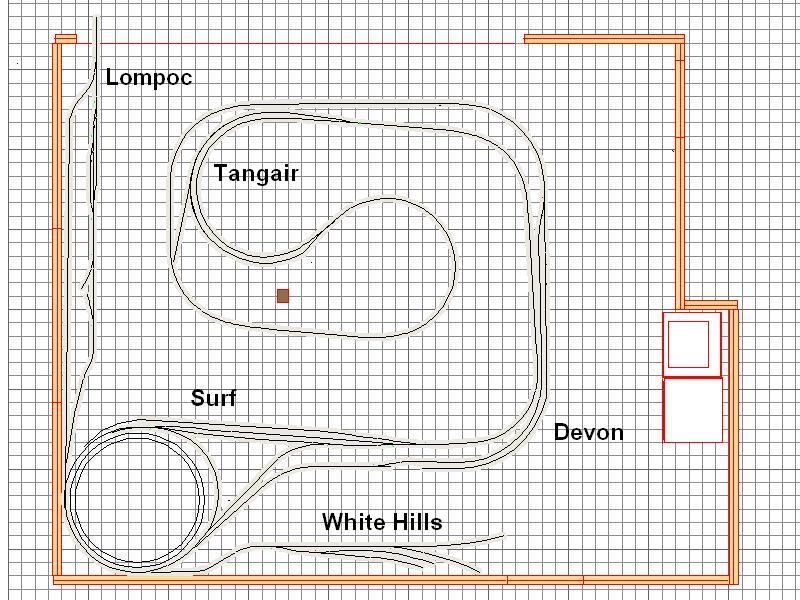
The near light has been added giving additional light to the mine at White Hills (top left) and the east staging yard (bottom left) as well as the main line and siding at Goleta (bottom right) and Devon (top right)
 
The top light was added after moving the other light the other direction providing more light
for Surf, Carpinteira, and Santa Barbara
 

Tuesday, October 21, 2014

Getting Closer: Test Run

Well, I had the local club over for another attempt which usually means finding lots of problems and placing more red tape.  

The week before had been unseasonably hot.  This caused a short somewhere in my less than perfect trackwork.  I worked for several hours trying to locate the culprit.  I isolated the layout's sections and determined that it was on the upper level's higher section.  I got lucky and found a gap between track and a frog that was essentially connecting both sides of the track together.  The gap was widened and I was able to operate locomotives over the entire layout once again.

I had been running two 4-axel locomotives - a Kato GP35 and an Athearn F59PHI.  I ran them in both directions on the main and a few sidings.  Everything seemed to be working well. 

The club members showed up and I handed out a couple throttles so someone else could run and find the problems.  Everything  went well.  Then one of the engineers decided he would try something more challenging.  I had a short 6 car train sitting on the Goleta siding.  I had run it a little a while back but had put it in the siding.  The engineer of the GP35 decided to run the train so he ran the engine by the siding switch, uncoupled the train from the locomotive it was with and rolled it out of the siding and up to the lone locomotive.  Off he went with the train.

There were a few problems with the caboose which may be a little on the light side weight wise, but the train made it around several times.  On one of the trips, the engineer became a railfan and took some video with his cell phone.  We had to censor some of the background noise on the first half but here is the video:
You can also see the video on YouTube at https://www.youtube.com/watch?v=8CTgckMsOJI

The other club member, operating the F59PHI was jealous and not to be outdone, grabbed some Amtrak passenger coaches which were sitting in the Santa Barbara Yard.  The longer cars and non-Kadee couplers caused some difficulties but the passenger train did travel some distance with some help.  I guess I need to change those couplers.

So I am closer to an operating session.  One fellow operator, who has been clamoring for a session, suggested getting together for a short session and lunch.   I told him I wanted to get a little closer first.  His reply was:
             "Closer" never happens.  I've seen documented evidence of a
              train successfully running on the SP SB Sub. You are there,
              not close.  No one is expecting perfect reliability, especially
              at a first session."


I still want to tweak the trackwork a bit more and "test run" all the trains I expect to run, but I hope to have a session within a couple months.

Southern Pacific Santa Cruz Division

One of my big problems with the SP Santa Barbara Subdivision is that I really enjoy operating on other peoples layouts to the detriment of progress on my own.  This post is from Gary Siegel's Southern Pacific Santa Cruz Division.  I have enjoyed working on its construction and operating on the 'finished' railroad.

It is a 1:32 scale model of portions of the former narrow gauge South Pacific Coast Railroad from Santa Cruz to San Jose. [Originally, the railroad went all the way to Alameda, CA near Oakland.]
In the early 1900's the Southern Pacific standard gauged the line.  It became very popular in the 1920's with a train called the "Sun Tan Special" which ran from San Francisco to the beach and Boardwalk in Santa Cruz.  In 1934, SP stopped the passenger service and soon after stopped freight service abandoning the line in the 1940's.  Gary has modeled the line as if it were the 1970's.

The mass of the larger locomotives and rolling stock, along with the Tsunami sound systems make operations very enjoyable.  We usually run with a dispatcher who communicates with the crews via FRS radios.  The crews actually do work along the way, setting out and picking up cars at various stations.  At Felton there is a branch line to Boulder Creek and beyond.  We sometimes run passenger trains and almost always run a McKeen car for the passenger service on the branch.  Here are a few photos of the McKeen car.

McKeen car at Boulder Creek

McKeen car in the trees

McKeen car on the Boulder Creek Branch
passing under the bridge east of Felton

Here is a photo of a Baldwin VO-1000 working at Zayante.

Lastly, I have posted a video from the most recent run session on YouTube.  You can see the video here.  http://youtu.be/I24YowiGeMU

There are other videos of the SP Santa Cruz Division here:

You Tube video of SP Santa Cruz Division taken several years ago at a Parkinson's Association benefit
http://www.youtube.com/watch?v=-pBOQqt0e_s&feature=related

Cab ride east bound
http://www.youtube.com/watch?v=qWNxnhISsLE&feature=mfu_in_order&list=UL

HiDef video taken from a GP38-2 on the SP Santa Cruz division [You may want to turn down the volume as the engine sound can be overpowering. Also you may need to adjust the resolution depending on the speed of your internet connection.]
http://www.youtube.com/watch?v=blgMvDGlLG8&feature=mfu_in_order&list=UL

I am caught up on my late posts so there should be some progress noted on the SP Santa Barbara Sub in the next few weeks.

Aborted Operation Session

I often get very discouraged about my layout as I seem to come up against a wall - more psychological than physical.  Everytime I work on the layout I feel like I am not getting as much done as I need to.  Everything takes longer than I think it will, and if something can go wrong it does.

I did get in five more Tortoises.  I still have two more candidates.  I took
some breaks and wrote instructions for the yardmaster, assistant yardmaster, a couple of fixed switcher jobs and train briefs for locals, passenger, and freight trains.  The freight still need some work.

Several times I have hoped to have an operating session.  I have invited the local club members on numerous Tuesday nights over the past year*.  

Almost every time I try to get the railroad running and find more problems including shorts, loose rail, locomotive problems.  I will not bore you with a retelling of each and every attempt but here is what transpired one of the evenings.

I still was not ready when eight members showed up when the 7PM hour arrived but I explained the throttles and handed out three.  All were just locomotives - no cars.  One member took two Kato F40PH Amtrak units (one with sound) and managed a complete circuit of the layout.  That is about 330 feet and includes both levels and the helix up and down.  Another member took a GP35 across most of the upper level and down the helix and over some of the lower level to the Santa Barbara yard.  Another member took two tunnel motors from the east leg of the wye at Surf went away from the main and then back on the west leg entering the main.  He traveled west to Tangair where he pulled in the siding to allow the GP35 by and then came out to follow him back past the wye at Surf and down the helix.  We were having some issues in the helix so he reversed on the main and went over the complete upper level and then back to the helix where he went down to the first level and into the Santa Barbara yard.  All three engineers found issues with the trackwork and marked it with red tape so I have my work cut out for me.  We were operating for about an hour.  While all this sounds good, I am not sure I can count it as an operating session.

Here are some photos:
Paul, Jim, Art, John, and David.
David is the engineer on the two tunnel motors on the right.

Bob, Michael, and Joe in a deep discussion. 

And a short video:
          John even sings as the GP35 crosses the Santa Ynez River bridge.

*November 5, April 8,  July 8, and September 9